
MONITORING, EVALUATION, RESEARCH & LEARNING (MERL)
Evidence for Better Decisions and Greater Impact.
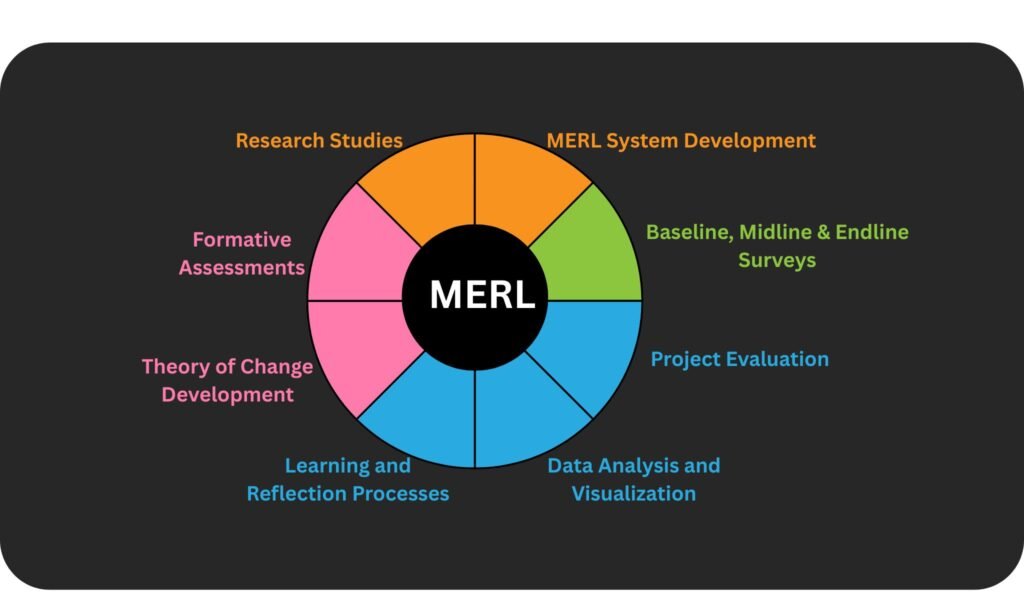
Evidence-based programming is not a slogan, it is a discipline that requires rigorous system design, skilled data collection, honest analysis, and a genuine commitment to learning from what the evidence shows, even when findings are uncomfortable. Bimba Nepal’s MERL team combines technical rigor with deep familiarity with Nepal’s development context, understanding methodological standards and the practical realities of data collection across the country. We design MERL systems that are not only technically sound but practically implementable by the program staff who will use them every day. Bimba Nepal uses modern equipment, professional tools, and efficient software for data collection, analysis and presentation. In addition to MS Excel for data cleaning, basic statistical summaries, and visual presentation, we use SurveyMonkey for quantitative data collection and SPSS & SAS for analysis. Similarly for qualitative research, we use audio recorder for data collection and NVivo for analysis.
MERL System Development
We develop Monitoring, Evaluation, Research and Learning (MERL) system for organizations that enable programs to track implementation progress, output delivery, and outcome achievement in real time, including indicator frameworks, data collection tools, reporting templates, data management protocols, and monitoring dashboards tailored to each program’s scale and reporting requirements.
Baseline, Midline, and Endline Surveys
We design, implement, and report on quantitative and mixed-methods surveys at program baseline, midpoint, and completion, covering indicator development, sampling design, questionnaire development and testing, enumerator training, digital data collection, data cleaning and analysis, and donor-ready report writing.
Research Studies
We design and conduct research studies- quantitative, qualitative, and mixed-methods- on socio-political issues, development themes, communication effectiveness, community needs, and program impacts. Research studies are conducted through rigorous methodological standards and reported in formats appropriate for academic, policy, and practitioner audiences.
Formative Assessments
Before programs are designed or campaigns are launched, formative assessments provide the evidence base that makes them effective. We conduct formative assessments that explore audience knowledge, attitudes, and practices; map existing services and gaps; and identify contextual factors that program design must account for.
Project Evaluation
We conduct process, outcome, and impact evaluations for development projects and programs, applying mixed-methods approaches, engaging stakeholders appropriately throughout the evaluation process, and producing reports that are analytically rigorous, practically useful, and honest about both achievements and limitations.
Data Analysis and Visualization
We transform raw program data and research findings into clear, compelling analysis and visual outputs, including statistical analysis, thematic coding of qualitative data, data visualization design, and the production of analytical reports, infographic summaries, and data dashboards for diverse audiences.
Theory of Change Development
We facilitate participatory Theory of Change development processes with program teams and stakeholders, clarifying program logic, articulating assumptions, mapping causal pathways, and producing ToC diagrams and narratives that serve as the analytical foundation for program design and evaluation.